How an eclipse is computed
- A solar eclipse is a shadow problem. The Moon casts two cones, the umbraumbraThe cone of the Moon's shadow within which the Sun is completely hidden. Where the umbra reaches the ground the eclipse is total. and the penumbrapenumbraThe outer part of the Moon's shadow within which the Sun is only partly hidden. Any place inside the penumbra sees at least a partial eclipse., and the computation asks where and when each cone touches the Earth.
- Bessel's method describes the shadow on one plane through the Earth's centre, the fundamental planefundamental planeThe plane through the Earth's centre perpendicular to the axis of the Moon's shadow. Its x axis lies in the equator pointing east, its y axis points north, and the shadow's cross-section on it is an exact circle., with eight numbers, the Besselian elementsBesselian elementsThe time-dependent quantities , , , , , and the constants , that describe the Moon's shadow relative to the fundamental plane, from which any eclipse circumstance can be computed.. Every map and every table is derived from those eight numbers.
- The elements carry the constants. The Sun's radius, the Moon's radius and the choice of ephemeris all enter here, so two tables of elements for the same eclipse can differ.
- The Earth rotates under the shadow, and how far it has rotated depends on ΔTΔTThe difference TT − UT1 between uniform Terrestrial Time, in which the elements are computed, and Universal Time, which follows the Earth's irregular rotation. About 69 s in 2024. It converts the hour angle μ to a geographic longitude, is known only by prediction for future eclipses, and is the largest error source for historical ones., the one input that cannot be computed in advance.
- The Moon is not round and the Sun has no edge. Those two facts, not the orbits, set the limit of what any prediction can promise at the edge of the path.
Two cones
Hold a coin in front of a lamp and it casts a dark inner shadow that narrows to a point, and a lighter outer shadow that widens. The Moon does the same with the Sun. The inner cone is the umbra. Where its tip reaches the ground, observers see a total eclipse. If the tip falls short of the ground, its extension beyond the tip, the antumbraantumbraThe extension of the Moon's shadow cone beyond its vertex, within which the Moon appears smaller than the Sun. Where the antumbra reaches the ground the eclipse is annular., sweeps the ground instead and observers see a ring of Sun around the Moon, an annular eclipse. The outer cone is the penumbra, and anyone inside it sees a partial eclipse.
The whole computation is the geometry of those cones against a rotating, slightly flattened Earth. The orbits of the Earth and Moon are known to centimetres from laser ranging, so the cones are known almost perfectly 1. What is not known perfectly is the size of the Sun, the shape of the Moon's edge, and how far the Earth has turned.
Bessel's plane
Friedrich Bessel's contribution in 1829 was to stop working on the Earth's surface and work instead on a plane through the Earth's centre, perpendicular to the line from the Sun through the Moon, the shadow axis. On that plane the shadow of a round Moon is a circle, and it moves almost in a straight line. Eight numbers describe it: the position of the axis on the plane (, ), the direction of the axis on the sky (, ), the radii of the penumbra and umbra on the plane (, ), and the half-angles of the two cones (, ). Published tables give the first six as short polynomials in time, valid for about six hours, and the two cone angles as constants 2 3.
The elements are computed from the apparent positions of the Sun and Moon and from four constants: the Sun's radius, the Moon's radius as a fraction of the Earth's (), the Earth's equatorial radius and flattening. Two values of are in use, one for the penumbra and a smaller one for the umbra, because the smaller value reproduces observed durations of totality better 4. Everything downstream inherits these choices.
From the plane to a map
To find where the shadow falls at a given instant, draw the line from the shadow's centre on the plane parallel to the axis and see where it meets the Earth's ellipsoid. That point is on the central linecentral lineThe locus of points where the shadow axis meets the Earth's surface. It is found at each instant from , and , and exists only while the axis intersects the Earth.. Repeat for the edges of the umbral circle and you get the northern and southern path limitpath limitThe northern or southern boundary of the umbral (or antumbral) path on the ground, where the duration of totality (or annularity) falls to zero. Smooth-limb limits assume a spherical Moon and ellipsoidal Earth. True-limb limits include the lunar limb profile and terrain. lines. Repeat for the penumbral circle and you get the outline of the region seeing a partial eclipse. The mathematics is a square root for the centre and a one-dimensional root-find for the limits, both given in full in the global circumstances notes 5.
The duration of totality at a point on the central line is the umbral diameter divided by the speed of the shadow relative to the ground. The shadow moves at about a kilometre a second, so a 100 km umbra gives about two minutes 6.
From the plane to one place
For a single observer the question is reversed: project the observer onto the fundamental plane, and ask when the distance from the observer's projected position to the shadow centre equals the shadow radius. That gives first and fourth contact for the penumbra and second and third contact for the umbra. The eclipse magnitudeeclipse magnitudeThe fraction of the solar diameter covered by the Moon at maximum eclipse. In the partial phase it is . Inside the umbra or antumbra NASA reports instead the ratio of the apparent lunar to solar diameters, . is the fraction of the Sun's diameter covered at maximum; the obscurationobscurationThe fraction of the Sun's apparent disc area covered by the Moon, computed from the overlap of two discs and always 1 during totality. is the fraction of its area, which is a different number found from the overlap of two circles. NASA's own JavaScript calculator does exactly this in 1,200 lines, and the local circumstances notes walk through it 7 8.
The Earth turns
The elements are computed in Terrestrial Time, a uniform clock. Longitudes on the Earth depend on Universal Time, which follows the Earth's irregular rotation. The difference, ΔTΔTThe difference TT − UT1 between uniform Terrestrial Time, in which the elements are computed, and Universal Time, which follows the Earth's irregular rotation. About 69 s in 2024. It converts the hour angle μ to a geographic longitude, is known only by prediction for future eclipses, and is the largest error source for historical ones., is about 69 seconds today and drifts unpredictably by a fraction of a second a year. One second of error moves the whole eclipse about 350 m east or west at mid-latitudes. Predictions made years ahead for 2024 were 1.4 to 2.3 s off, and a canon of eclipses two thousand years ago carries an uncertainty of over four minutes, which is about a hundred kilometres 9 10.
The Moon is not round
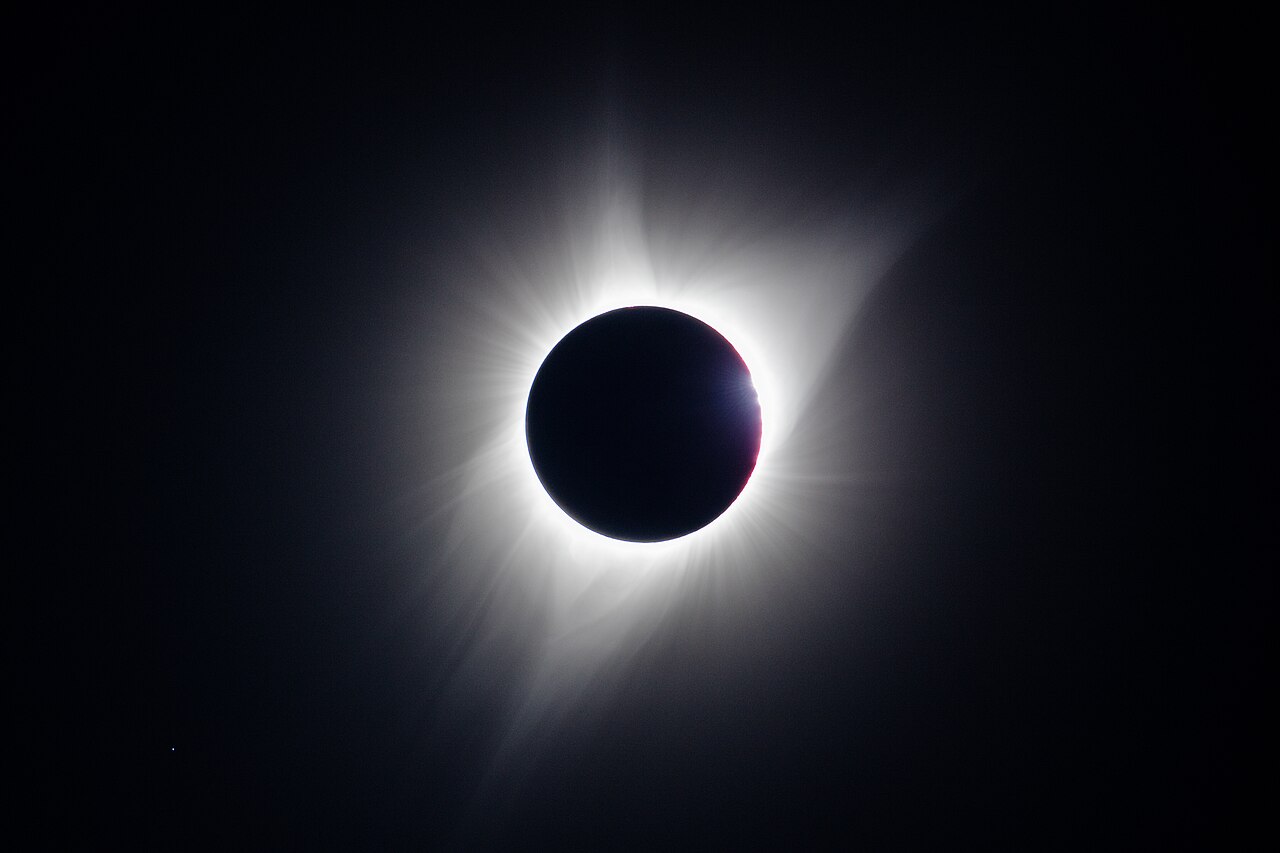
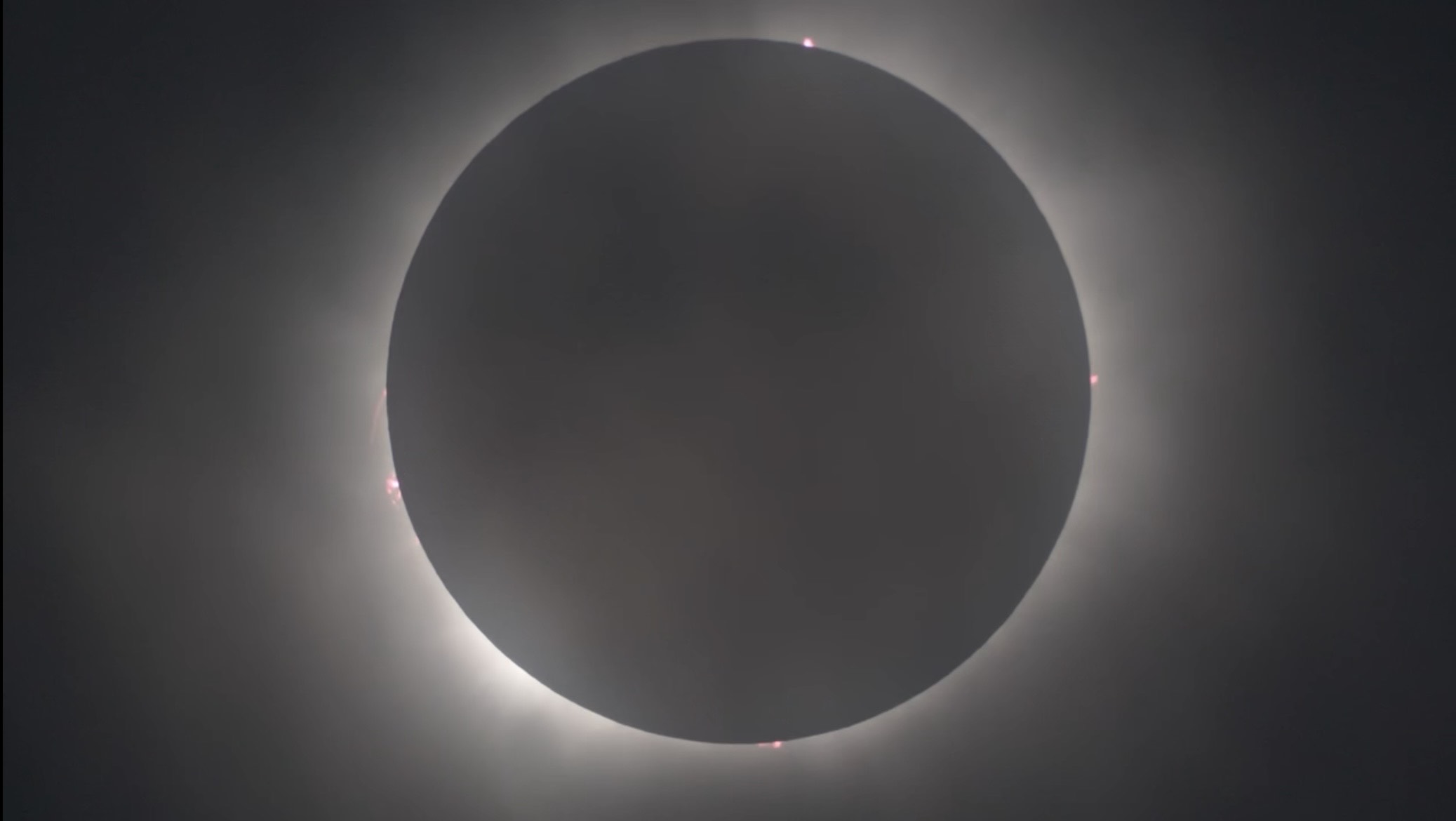
At the scale of an eclipse edge the Moon's silhouette departs from a circle by up to about 3 arcseconds, which is 6 km of lunar mountain and valley. A valley on the trailing edge lets sunlight through a few seconds longer; a mountain cuts it off early. Those are Baily's beadsBaily's beadsPoints of photospheric light shining through valleys on the lunar limb in the seconds around second and third contact. Their times at a site follow from the limb profile evaluated at each position angle.. Laser altimeters on the SELENE and Lunar Reconnaissance Orbiter missions have mapped the Moon to a few metres, so the lunar limb profilelunar limb profileThe height of the Moon's silhouette edge above a reference sphere, tabulated as a function of position angle around the disk for a given libration. It is what turns a smooth-disk eclipse prediction into one that knows where the valleys are. seen from any place at any instant can be built from a digital elevation model. Applying it moves second and third contact by 2 to 3 s anywhere in the path and by tens of seconds near the edge, and turns the umbra from an ellipse into a polygon with one side per valley 11 12.
The Sun has no edge
Totality means the last of the bright photosphere has gone. Where exactly the photosphere ends is a question of physics, not geometry. The value almost every prediction uses, 959.63 arcseconds at one astronomical unit, dates from 1891. Timing the beads at the edge of the path in eclipses since 2010 gives a Sun about a third of an arcsecond larger. That third of an arcsecond moves each edge of the path inward by about 600 m and, for someone standing near the edge, can take ten seconds off a short totality, and, combined with the lunar limb, a minute. It is the largest unresolved number in the subject 13 14.
Where the products come from
Fred Espenak's tables on the NASA eclipse site and EclipseWise are computed from the elements with a round Moon and observers at sea level, and Espenak states that the limb moves the limits by 1 to 3 km. Xavier Jubier's interactive maps add limb corrections at a clicked point. NASA's Scientific Visualization Studio, in Ernie Wright's work for 2017, 2023 and 2024, puts every map pixel at its true height and tests it against the true limb, and is the reference standard against which the others are measured. Dave Herald's Occult is the occultation community's tool for beads. The rest of the world's apps embed one of these or NASA's element tables 15 12 16.
The reports turn this into a pipeline a developer can build, with the constants, the data files and the tests.
References
- 1peer-reviewed Park, Folkner, Williams, Boggs (2021). The JPL Planetary and Lunar Ephemerides DE440 and DE441. Astronomical Journal 161, 105 Open-access HTML read through the fetch tool's extraction, not the PDF. Spans, geodetic precession on librations, LLR to 2020 March, 20 cm early and 1.3 cm recent rms, ICRF3, libration angles stored in the files, DE440 for modern data and DE441 for historical.
- 2peer-reviewed Explanatory Supplement to the Astronomical Ephemeris and the American Ephemeris and Nautical Almanac (1961), section 9B Eclipses and Transits Read in full (OCR text). Definitive almanac formulation: fundamental plane, point Z, x y z, mu from ephemeris sidereal time, sin f1 sin f2 with tabulated numerators for k = 0.272274, 0.2724807, 0.272281 and 0.2724880, c1 c2 l1 l2, sign convention, observer coordinates, ephemeris meridian 1.002738 ΔT, worked example 1961 Feb 15.
- 3primary Espenak, F., NASA GSFC, Besselian Elements for the Total Solar Eclipse of 2024 Apr 08 Read. Polynomial coefficients, t0 = 18:00 TDT, ΔT = 70.6 s, VSOP87/ELP2000-85, k1 = 0.272488, k2 = 0.272281, tan f1 = 0.0046683, tan f2 = 0.0046450, validity 15.00 to 21.00 TDT, least-squares fit to five samples over six hours, centre-of-mass statement.
- 4primary Espenak, F., NASA GSFC, Mean Lunar Radius (reference page for the eclipse bulletins) Read. History of k: 1968-1980 NAO two values 0.2724880 and 0.272281, IAU 1982 k = 0.2725076, Espenak's use of 0.272281 for umbral contacts, 1986 Oct 03 misclassification.
- 5peer-reviewed Explanatory Supplement to the Astronomical Ephemeris and the American Ephemeris and Nautical Almanac (1961), chapter 9 Eclipses and Transits, section B Solar eclipses fundamental equations and section C predicted data The primary algebra for Besselian elements, the observer in the fundamental frame, the auxiliary elements a' b' c', central line, limits, outline, maximum-eclipse, rise/set and greatest-eclipse curves, with worked examples for 1961 Feb 15. Read the OCR full text on archive.org (djvu text); OCR errors were resolved against the 1992 edition and the Stellarium code.
- 6peer-reviewed Explanatory Supplement to the Astronomical Almanac (1992), chapter 8 Eclipses of the Sun and Moon, by Alan D. Fiala and John A. Bangert Sections 8.353 to 8.3565 and 8.361: the conditional equation with tan^2 f, the flattening iteration in gamma, the Q-scan and 1e-5 tolerance for limits, Mikhailov's path-width formula (8.3553-5), discriminants for contacts, eclipse-map conventions. Read the OCR full text; equation 8.3553-5 is scan-damaged and was reconstructed from Stellarium's transcription.
- 7peer-reviewed Explanatory Supplement to the Astronomical Ephemeris and the American Ephemeris and Nautical Almanac (1961), section 9D "Solar eclipses: local circumstances", pp. 241-249 Official almanac chapter. Read from the archive.org OCR text (var/downloads/es1961_djvu.txt, lines 40694-41460). Gives the observer coordinates, hourly variations, greatest phase, contact-time solution with the auxiliary angle psi, position angles Q and V, magnitude, degree of obscuration and the differential corrections for longitude, latitude, height and Delta T.
- 8primary Chris O'Byrne and Fred Espenak, "Javascript Solar Eclipse Explorer", program.js (NASA GSFC, 2007, GPL) Read in full (var/downloads/jsex_program.js, 1200 lines). The reference implementation of the Explanatory Supplement local-circumstances method in code: observer constants, time-dependent and time-and-location-dependent circumstances, Newton iteration for mid eclipse and the four contacts, P, V, altitude, azimuth, magnitude, obscuration and sunrise/sunset handling.
- 9primary deltat.data: monthly determinations of TT - UT1 (USNO) Read on 2026-09-15. 2017 Aug 1: 68.8373 s; 2017 Sep 1: 68.8477 s; 2024 Apr 1: 69.1983 s; 2024 May 1: 69.2018 s; last row 2026 Apr 1: 69.1330 s.
- 10primary Espenak, Uncertainty in Delta T, NASA GSFC eclipse site (2007), adapted from the Five Millennium Canon Full HTML read via curl. Morrison & Stephenson 2004 sigma = 0.8 t^2, tables of sigma and longitude uncertainty from -4000 to +5000, Huber 2000 model.
- 11peer-reviewed Herald, D. (1983). Correcting predictions of solar eclipse contact times for the effects of lunar limb irregularities. Journal of the British Astronomical Association 93, 241-246 Read in full from the ADS scan (page images). The displacement-curve method: h = 960 (M-1)(1-cos P), r = 0.97 M n arcsec per second, radial rate r cos(PA-N), the path-limit factor 1.863 km per arcsec times sqrt(sin^2 D / sin^2 a + cos^2 D), the limiting magnitudes for total and annular eclipses, and the error budget.
- 12peer-reviewed Wright, E. and Young, C. A. 2024, A Raster-oriented Method for Creating Eclipse Maps, AJ 168, 163 The paper. Read in full from the Wayback capture of the IOP PDF dated 2024-11-19 (iopscience.iop.org/article/10.3847/1538-3881/ad6b23/pdf), extracted with pdftotext. CC BY 4.0. Sections 4 and 5 give the limb-profile construction and the limb test; Appendix A gives the SPICE calls.
- 13peer-reviewed Quaglia, L., Irwin, J., Emmanouilidis, K. and Pessi, A. (2021) Estimation of the eclipse solar radius by flash spectrum video analysis. ApJS 256, 36 Defines the eclipse solar radius, reports 959.95 ± 0.05 arcseconds from the 2017 flash spectrum at the southern limit, gives duration and limit-distance sensitivity to the radius and compares Occult, Solar Eclipse Maestro and Irwin's model. Full arXiv PDF read.
- 14trade Besselian Elements team, Experimentally Testing Eclipse Maps Accuracy (2024) Read via WebFetch summary. Stephenville, Texas, 2024 April 8. Observed totality 13.7 s (C2 18:39:06.6, C3 18:39:20.3 UTC) versus six predictions from 12.9 s (Irwin) to 65 s (timeanddate). Authors' own experiment, so trade grade.
- 15primary Espenak, F., Path of Total Solar Eclipse of 2024 Apr 08, NASA Eclipse Web Site VSOP87/ELP2000-85, Delta T 70.6 s, the 1 to 3 km and 1 to 3 s limb caveat, central line table, greatest eclipse 18:17:18.3 UT. Read via fetch tool.
- 16company Occult v4 (David Herald) home page Fetched with curl 2026-09-15. Feature list, C#/.NET 4.5, 42 data files, installer sizes. Eclipse-specific help is inside the Windows help file and was not read.