Computing Solar Eclipses
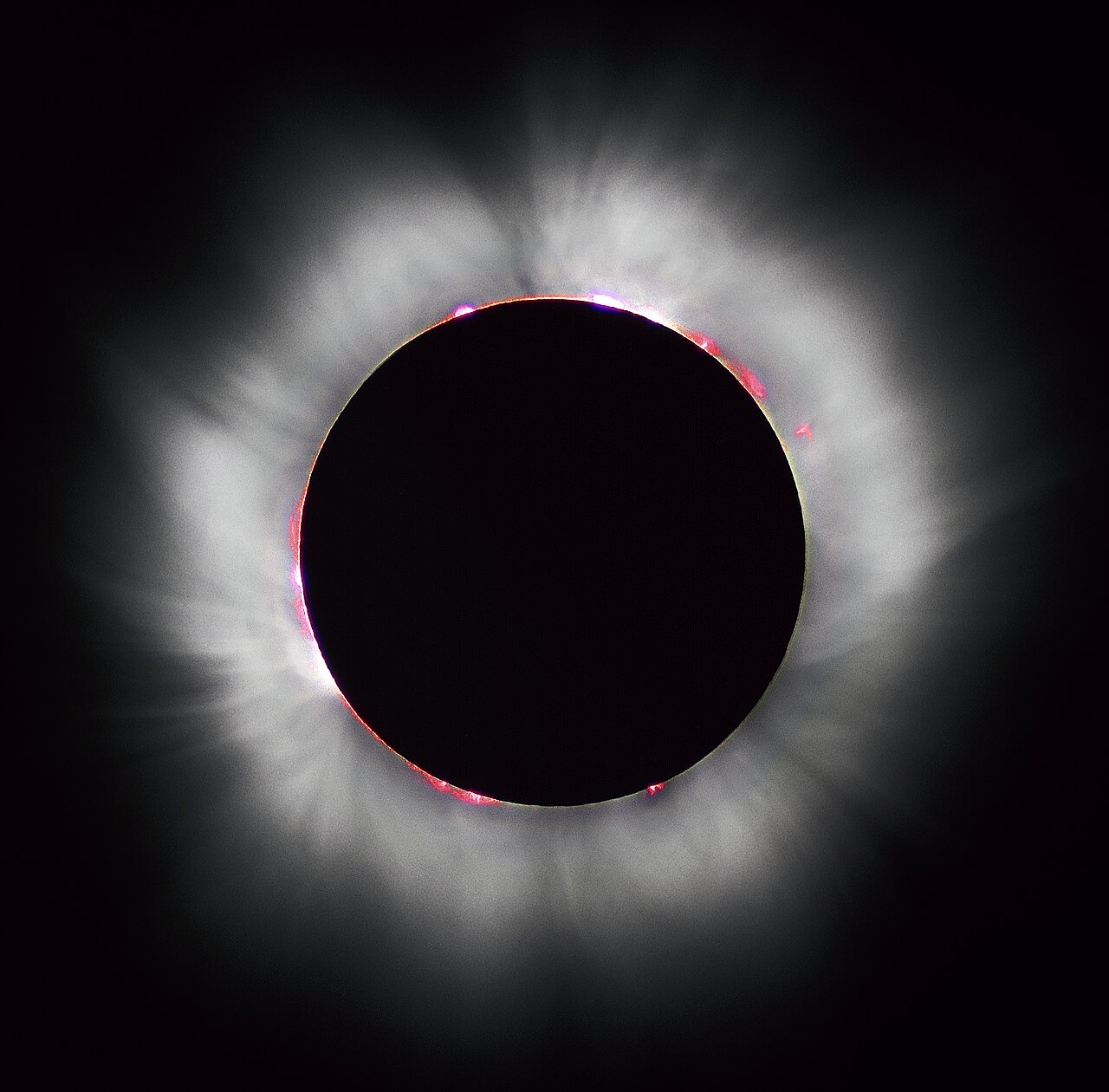
Solar eclipse predictions are published by a handful of people and programs, and they agree to a few hundred metres at the edge of the path. The places where they disagree are where the modelling decisions live. This site sets out what a developer needs to know to compute every product, from the list of eclipses in a century to the second totality begins on one hillside, and to know how good the result is: the algorithm, the constants and where each one came from, the datasets, the published implementations, and what is still unsettled.
This site was researched and written with Anthropic's Claude — every note, report and figure in the tree below. It was built to a fixed method: primary documents and published code in preference to secondary coverage, formulas quoted with their constants rather than paraphrased, negative findings recorded as findings, and a graded citation on every substantive claim. The grade is rendered beside each reference, so what a number rests on is visible where it is used. That is the check on the text, and it is the one worth using: follow a citation before relying on a figure here. Method and source policy states the rules in full.
- One algorithm underlies every eclipse product: Bessel's fundamental-plane method, fully stated in the 1961 Explanatory Supplement. Predictors differ in their constants and data, not their mathematics 3.
- Three inputs decide the edge of the path: the solar radius, the lunar limb profile, and terrain. Each is worth 0.6 to 3 km at a limit. The ephemeris is worth under a metre 4 5.
- The state of the art is Wright and Young 2024, NASA SVS's raster method with an 18,000-element lunar limb from LRO and SELENE topography and every observer on the terrain. It is published, open access, and has no public code 6.
- The solar radius is the unresolved constant. The 1891 value of 959.63″ that almost everyone uses is a third of an arcsecond smaller than what eclipse observations measure. At one 2024 edge site that difference was the last 11 s of a 65 s smooth-Moon prediction that observation cut to 13.7 s 2.
- No open-source code computes a limb-corrected path edge. Stellarium and NASA's JavaScript cover the smooth-Moon problem completely 7.
Start here
- Executive summary: the findings that carry the most weight.
- Pipeline design: nine stages with formulas, constants, outputs and validation cases.
- Error budget: every input ranked in seconds and metres.
- Reading list: the papers, code and datasets in order.
- Primer: start here if you have not computed an eclipse before.
The raw notes
Eleven topics, each a folder of notes with quoted formulas, graded citations and the questions it could not close.
| Topic | What it settles |
|---|---|
| Foundations | The eight Besselian elements, the equations from ephemeris to elements, the constants and their provenance |
| Catalogues and types | How eclipses are enumerated and classified, and which catalogues to use as fixtures |
| Global circumstances | Central line, limits, outlines, rise and set curves, durations, and the data products |
| Local circumstances | Contact times, magnitude, obscuration and position angles at one site, and the corrections |
| Lunar limb profile | Watts, Kaguya and LOLA, the DEM-to-profile geometry, and Baily's beads |
| Solar radius | Every value in circulation, what each measures, and the effect on products |
| Earth model and time | The ellipsoid, terrain and geoid, ΔT models, refraction, frames |
| Lunar and solar model | The DE ephemerides, centre of mass against figure, , libration |
| Software and repositories | Four production lineages, the open libraries, thirty repositories, the datasets |
| Validation | Observed against predicted, predictor disagreements, the error budget and protocol |
| NASA SVS and Ernie Wright | The 2024 paper, the SVS products and data, and the comparison with other predictors |
Reference
- Glossary: the jargon, defined standalone, with the formula where a term is really a quantity.
- Open questions: what this corpus could not close, each naming the artefact that would close it.
- Method and source policy: the grades, and what each one is allowed to prove.
References
- 1primary Total Solar Eclipse of 2024 Apr 08, interactive Google map (NASA GSFC eclipse web site) Read. States VSOP87/ELP2000-85, Delta T = 70.6 s, that predictions do not include lunar limb effects, that limb corrections shift limits by ~1-3 km, durations by ~1-3 s and greatest duration by ~10-20 km, and that corrected predictions are posted 12-18 months ahead.
- 2trade Besselian Elements team, Experimentally Testing Eclipse Maps Accuracy (2024) Read via WebFetch summary. Stephenville, Texas, 2024 April 8. Observed totality 13.7 s (C2 18:39:06.6, C3 18:39:20.3 UTC) versus six predictions from 12.9 s (Irwin) to 65 s (timeanddate). Authors' own experiment, so trade grade.
- 3peer-reviewed Explanatory Supplement to the Astronomical Ephemeris and the American Ephemeris and Nautical Almanac (1961), section 9B Eclipses and Transits Read in full (OCR text). Definitive almanac formulation: fundamental plane, point Z, x y z, mu from ephemeris sidereal time, sin f1 sin f2 with tabulated numerators for k = 0.272274, 0.2724807, 0.272281 and 0.2724880, c1 c2 l1 l2, sign convention, observer coordinates, ephemeris meridian 1.002738 ΔT, worked example 1961 Feb 15.
- 4peer-reviewed Quaglia, Irwin, Emmanouilidis & Pessi (2021), Estimation of the Eclipse Solar Radius by Flash Spectrum Video Analysis, ApJS 256:36 Full PDF read (var/downloads/quaglia2021_flash_spectrum_ApJS.txt). Flash-spectrum video from a site a few hundred metres inside the 2017 southern limit near Vale, Oregon. S = 959.95 +/- 0.05 arcsec. Gives sensitivity of duration and limit distance to solar radius, and compares Irwin's model with Occult and Solar Eclipse Maestro.
- 5peer-reviewed Park, Folkner, Williams, Boggs (2021). The JPL Planetary and Lunar Ephemerides DE440 and DE441. Astronomical Journal 161, 105 Open-access HTML read through the fetch tool's extraction, not the PDF. Spans, geodetic precession on librations, LLR to 2020 March, 20 cm early and 1.3 cm recent rms, ICRF3, libration angles stored in the files, DE440 for modern data and DE441 for historical.
- 6peer-reviewed Wright, E. and Young, C. A. 2024, A Raster-oriented Method for Creating Eclipse Maps, AJ 168, 163 The paper. Read in full from the Wayback capture of the IOP PDF dated 2024-11-19 (iopscience.iop.org/article/10.3847/1538-3881/ad6b23/pdf), extracted with pdftotext. CC BY 4.0. Sections 4 and 5 give the limb-profile construction and the limb test; Appendix A gives the SPICE calls.
- 7company Stellarium src/core/SolarEclipseComputer.cpp Read from a sparse clone at commit 69888f4 (2026-09-14). 2,183 lines. Besselian elements, k and s constants, Explanatory Supplement references, KML and PNG map export.